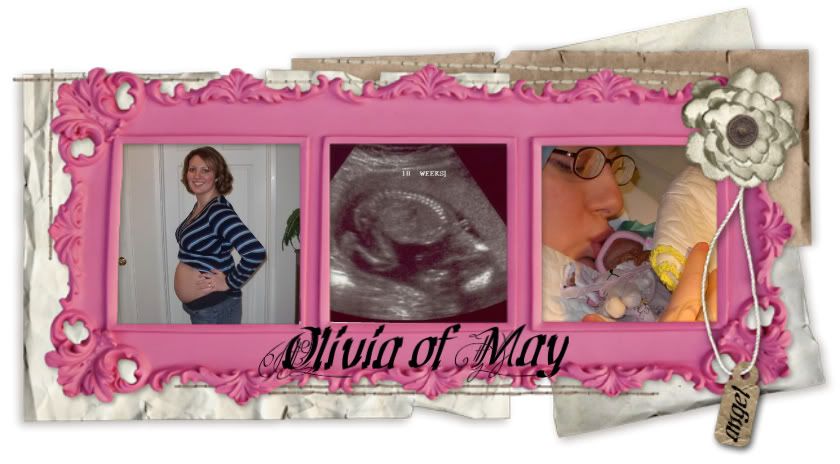










Some gals who check this blog regularly ask why I never post anything personal. I'm really not sure why. It's not that I don't still grieve a little every day. It's not that I'm worried that friends and family will read it and judge me. I don't know why. Lately I've been wanting to post something personal. It's some feelings and thoughts I've been having. I've been thinking it over in my mind for about a week now and had all the perfectly formed sentences in my brain to correctly express what I wanted to convey. Now it's all left me. However, it seems important to me so I'll press on.
Olivia's third angel day or birthday, or whatever you'd like to call it was May 1st. It's never overwhelmingly depressing. Actually a little bittersweet. The reason for the bitter is obvious, but the sweet seems surprising. Just now I'm wondering where that comes into play and I think it must come from the knowledge I have of where she's at and that we are an eternal family and that I will see her again one day. Point is that it wasn't a horrible day/week. Of course I was sad and cried and had a tough time, but it wasn't horrible...until the next weekend.
The little boy across the street was born a week after Livy. I remember being pregnant right along with his mom and chatting a couple of times about the babies. And about a month after Liv was born, on my first venture to the mailbox, her husband asked if we had our baby early because I was obviously not pregnant any more, I said we did, and because of the smile on his face that told me he was going to say congratulations or something of the sort I immediately spat out that "she didn't make it". For some reason I remember the exact words I used. Which somehow reminds me of how the cleaning ladies at the hospital the day after Olivia was born and we were in a postpartum room told us congratulations and I somehow smiled and said thank you.
Anyway, every time I see this precious little boy playing in the yard I remember Olivia. Every time he falls I want to run to his rescue. Every time he does something big for his age I feel a little proud. It is odd. It feels odd to me. But it just happens.
Well, this little fella had a huge third birthday party in his front yard with balloons, decorations, a big bounce house, lots of family, and tons of presents. That was a horrible day. I couldn't tear my eyes away. I sat just inside a front window in the shadow and balled. I tried to move. Then I walked away a few times, but I always came right back. I watched this family celebrate the third anniversary of this precious boy's birth and grieved at the emptiness of our home. Yes, we have been blessed with a rainbow baby. But that rainbow baby should have an older sister. There should be half deflated balloons in our home from the previous weekend when we had his sister's third birthday party. There should be a room downstairs painted pink with lacy curtains. I should have been telling her to hush as not to wake baby brother from his nap. It was the worst day I've had in a long time.
Then came Mother's Day. I didn't go to the first hour of church because our rainbow baby was napping, but I doubt I would have went anyway. I have gone every Mother's Day in years past, but because of that birthday party this Mother's Day was harder somehow. All in all it turned out to be another bittersweet but not horrible day.
Then there was Memorial Day. This day has never really gotten to me. I think I recall in a past post saying the same thing. Where I grew up, in the South, Memorial Day was a day to honor the deceased military. Not until I moved to the West did I learn that people used it as a day to remember all their beloved dead. My first Memorial Day after losing Olivia was spent in frustration at all the children at the cemetery who trampled the lawn and played with all the flowers, wind chimes, and toys left at the angel's graves. The next year I bought and put up a picket fence around Liv's grave to keep the kids away. It actually worked. It's been more of a day to protect "her" than to remember her/grieve for her. When I went the day before Memorial Day this year to put up her fence it was dusk. As I started to push the stakes of the fence into the ground tears started to fall. Angry tears. Anger from having a daughter's grave to have to protect. Angry that she wasn't here and I had to care for her grave instead of her. Then they turned to tears of sadness and I wept. I got all the fencing put down except for the piece at the bottom of her headstone. Though there were people around I knelt down, laid my head on her headstone, and wept. I felt I had no strength to do anything but that. No strength left to hold back the tears. No strength left to pick myself up and walk away. It just happened. And gratefully the few people there just let it happen. It didn't take too long for me to use the happy thoughts of where she is and how I'll see her again one day to drive the sadness away and dry up those tears. I suppose it was a needed cry. Well, anyway aren't all cries needed cries? I drove home sane again, for every mother of an angel goes through seconds of insanity during these brief and intense grieving moments.
The next day we visited her grave. The cemetery was absolutely gorgeous. It seemed every grave was decorated with flowers and/or balloons. Driving to "Baby Land" Liv's place was easy to see thanks to the pretty, white fencing. Our earthly family of three got out and placed our gifts there for her. Sometimes my visits are unfeeling, like I just haven't got the energy to let myself feel anything. This was one of those times. We took our pictures and left.
Just now while typing this I realize how the fencing is the only way I can show my motherly protection for her. I've always realized how the flowers, ribbons around the top of the vase, dolls with bottles, figurines and trinkets are the only gifts I can give her, but just now realized what that fence truly means to me.
So, it's been a tough month or so, on and off. I do feel. I do grieve. Though I don't post it often here I am experiencing these things right along with you angel mothers, and I wanted to share this most recent span of grief with you. You are not alone. All my love.
03 June 2010
It's Personal


09 September 2008
Letting Go

To let go isn't to forget, not to think about or ignore. It doesn't leave feelings of anger, jealousy, or regret. Letting go isn't winning and it isn't losing. It's not about pride and it's not about how you appear and it's not about obsessing or dwelling on the past. Letting go isn't blocking memories or thinking sad thoughts and doesn't leave emptiness, hurt, or madness. It's not giving in or giving up. Letting go isn't about loss and it's not defeat. To let go is to cherish memories but to overcome and to move on. It is having an open mind and confidence in the future. Letting go is accepting. It is learning and experiencing and growing. To let go is to be thankful for the experiences that made you laugh, made you cry and made you grow. It's about all that you have, all that you had, and all that you will have soon again. Letting go is having the courage to accept change and the strength to keep moving. Letting go is growing up. It is realizing that the heart can sometimes be the most potent remedy. To let go is to open a door and to clear a path and to set yourself free.
-Gloria Abraham
15 June 2008
A Childless Father

A childless father sits silent
His still baby in his mind
His grief looked down upon
Didn’t he suffer a great loss?
A childless father fell to his knees
He screams to God in anger
He was shaken to his core
Didn’t his child deserve to live?
A childless father is strong and tall
Let him be helpless by his wife
Let him grieve so that his heart heals
Didn’t he suffer a great loss?
A childless father needs support
He is angry and sad because of his pain
He lost his child and the dreams of that life
Didn’t his child deserve to live?
-Tara Luning
15 January 2008
Unless You've Lost A Child...

Don't ask us if we are over it yet. We'll never be over it. A part of us died with our child. Don't tell us they are in a better place. They are not here with us where they belong. Don't say at least they are not suffering. We haven't come to terms with why they suffered at all. Don't tell us at least we have other children. Which of your children would you have sacrificed? Don't ask us if we fell better. Bereavement isn't a condition that clears up. Don't tell us at least we had our child for the time we did. What time would you choose for your child to die? Don't tell us God never gives us more than we can bear. Don't avoid us. We don't have a contagious disease, just an unbearable pain. Don't tell us you know how we feel unless you have lost a child. No other loss can compare to losing a child. It's not the natural order of things. Don't take our anger personally. We don't know who we are angry at and why and may lash out at those closest to us. Don't whisper behind us when we enter a room. We are in pain, but not deaf. Don't stop calling us after the initial loss. our grief does not stop there and we need to know others are thinking of us. Don't be offended when we don't return calls right away. We take each moment as it comes and some are worse than others. Don't tell us to get on with our lives. We each grieve differently and in our own time frame. Grief can not be governed by any clock or calendar.
Do say you're sorry. We're sorry too, and your saying that you share our sorrow is far better than saying any of those tired cliches you don't really mean anyway. Even if you're more sorry that we hurt than you are at our child's passing. It wasn't your child and you weren't as close to them as we were so we'll understand. Just say you're sorry. Do put your arms around us and hold us. We need your strength to get us through each day. Do say you remember our child, if you do. Even if you just remember us being pregnant or how happy we were when we were pregnant. Memories are all we have left and we cherish them. Do let us talk about our child. Our child may have or may not have lived, but still lives in our hearts, forever. Do mention our child's name. It will not make us sad or hurt our feelings. Do let us cry. Crying is an important part of the grief process. Cry with us if you want to. Do remember us on special dates. Our child's birth date, death date, due date, and holidays are a very lonely and difficult time for us without our child. Do send us cards on those dates saying you remember our child. We do. Do show our family that you care. Sometimes we forget to do that in our own pain. Do be thankful for children.
-taken from the "Utah Share" Newsletter January/February 2008
15 May 2007
For Friends and Family

The primary purpose is to provide support toward positive resolution of grief experienced at the time of or following the death of a baby. This support encompasses emotional, physical, spiritual and social healing, as well as sustaining the family unit.
The secondary purpose is to provide information, education, and resources on the needs and rights of bereaved parents and siblings. The objective is to aid those in the community including family, friends, and employers, member of the congregation, and caregivers and others in their supportive role.
Share is a non-denominational, not-for-profit (501c3) organization, providing support, comfort and hope. Additional information about Share can be obtained by contacting:
National Share Office
St. Joseph Health Center
300 First Capitol Drive
St. Charles, MO 63301-2893
Office Phone: 636-947-6164
Toll Free Phone: 800-821-6819
Fax: 636-947-7486
E-mail: share@nationalshareoffice.com
Website: http://www.nationalshareoffice.com/
Office Hours: Monday-Thursday 9:00 am – 4:00 pm Central Time

Dear Friend:
Someone very special to you has just experienced the death of a precious child. This is an extremely difficult situation because most people never expect a child to die and after the initial grief, they do not know how to interact with the grieving parent. As a parent whose baby recently died, I would like to mention some things that might make the situation easier for you and the grieving parent:
1. Realize that saying “I’m sorry” at any time after a baby has died is never inappropriate or too late.
2. Understand that the length of time a baby is carried or the amount of time a child lives does not determine his/her value or the impact that the child has on the parents’ lives. To ignore what has happened in hopes that the grief will pass is to diminish the worth of a child that was loved from the time of the awareness of its existence, long before its birth.
3. Realize that just as no one can replace a mother who dies, a new baby cannot replace a child who has died. All children are individuals, conceived separately, born separately, and loved separately. It is no different with a child that dies before, during, or shortly after birth. A parent cannot and should not be expected to “save” the love they have for their dead child to give to the next child. The ability to create another baby is not a way to resurrect a dead child therefore, it should not be thought of as a complete comfort. Not only is it unfair to the dead child, but it makes the next child a substitute.
4. If you are uncomfortable about discussing the death of the child with the parents because you think they won’t want to talk about it, don’t shy away. Simply say something like “I just want you to know that I want to listen if you need to talk”. Call frequently to ask how the parent is adjusting. If you live close to the parents, take the initiative to get together for lunch or some sporting activity (offer frequently, but don’t force it). Let the parents set the pace but constantly show them that you are open and interested. It may be horrifying for you to hear some details of the death, but it is much worse for the parents to experience the trauma and then have to keep it to themselves because they know it will be hard on you. When they tell you how they feel, refrain from making judgments and setting timetables.
5. Realize that a child is still the product of the parents’ love and the joy of their lives. There is joy and pain. The joy doesn’t end when the child dies, and the pain doesn’t end as soon as the funeral is over and the cards are sent- accept both. Don’t try to take the pain away. Parents need to feel it, hard as it is to see their pain, they need to grieve.
6. If the child has a name, use it. Try to remember the parents with a note or a phone call on their first Mother’s Day or Father’s Day, as well as the baby’s predicted due date and the first year anniversary of the child’s birth and death (even the first few monthly anniversaries).
Finally, if I can convey one thing to you in hopes it will make a difference, it is this: please make an effort not to underestimate the depth of the pain, the length of the grief, and most importantly, the difference your support and involvement can make during this painful adjustment. There may not be any other time when you are needed more than now. If you distance yourself because you’re uncomfortable until you think a reasonable amount of time has passed, you may find a different kind of distance and hurt between yourself and the grieving parent. If you share the experience, everyone will come out of it stronger.
Praying that God will guide and strengthen you.
A Mother
National Share Office, St. Joseph Health Center, 300 First Capitol Drive, St. Charles, MO. 63301 - May 1999

TO OUR FAMILY & FRIENDS
OUR GRIEF EXPERIENCE SHARED
We want to share with you some of our feelings and how you can help and support us. We have suffered a tremendous loss, and we need to grieve. Even though this may be uncomfortable for others around us, it’s something we MUST do. We won’t be over this in a few weeks as most people expect. We will be able to adjust to the loss of our precious child if we are given the time needed to grieve. (Average intense grieving is 18-24 months). However, we will not be the same people we were before our loss.
We may need to talk about our baby, how much we loved our child and the details of our experience. Even though we may not have many memories we suffer from broken dreams. During this time we need others to be there and listen to us time and time again. This is the kindest thing a person can do for us. We do not want to forget our baby and we will need to mention him/her in the future. It would be appreciated if you would remember our baby, especially on difficult days such as anniversary days, birthdays, Christmas, and Mother’s and Father’s Day.
In our struggles with our grief, we may have difficulties with the following:
· Understanding our many emotions and feeling emotionally balanced.
· Coping with feelings of guilt, anger and jealousy.
· Dealing with normal daily functions due to lack of energy.
· Deciding what to do with our baby’s belongings.
· Coping with the individuality of our grief as a family and as a couple.
· Sharing family celebrations.
· Seeing babies/children that are the same age our child would have been.
· Needing to make major decisions such as subsequent pregnancies, moving, job changes, etc.
· Visiting the cemetery and purchasing a tombstone.
· Remembering our baby in special ways that are acceptable.
· Feeling different and subsequently feeling isolated.
· Dealing with physical symptoms that arise due to grieving.
Dealing with these many emotions takes a lot of courage and tedious work. It is worth it so we can have peace of mind and a physical well being.
Many of us will attend support group meetings. Support groups are not for weaklings. The meetings are a safe place where we can share our feelings and love for our baby. Others who have been through similar experiences validate our feelings. These meetings give us comfort and hope for our future.
If we sound a little selfish, please understand. Only after we are able to adjust and experience the journey of grief can we reach out and help others. One day we will be able to live life in a fuller manner.
We try not to criticize others. Before our baby died, we didn’t understand the full impact this loss had. We want to share this painful experience with you so others can understand our need for support. No one will be able to take our pain away, but perhaps they can be there and listen.
National Share Office, St. Joseph Health Center, 300 First Capitol Drive, St. Charles, MO 63301 - Catherine Lammert, May 1999

SUPPORTING A GRIEVING FAMILY
How to Help:
1. Be supportive-Visit or call to say, "I care and want to help."
2. Treat the bereaved couple equally. Men need as much support as women.
3. Be available. Parents need direct help providing a meal, doing errands, and baby-sitting their other children.
4. Allow the parents to talk about their child; ask but don’t pry.
5. Learn about the grieving process. There are many books available.
6. Don't be afraid of reminding the parents about the child. They have never forgotten. Letting them know you remember is comforting.
7. Be liberal with touching a grieving parent. They often have a need for contact.
DO Say:
1. I'm sorry.
2. I'm so sad for your loss.
3. I know this must be terribly hard for you.
4. How are you managing all of this?
5. What can I do for you?
6. I'm here, and I want to listen.
7. Talk as long as you want. I have plenty of time.
DON’T Say:
1. It's all happened for the best.
2. You're young. You can have others.
3. Now you'll have an angel in heaven.
4. You're better off having this happen now, before you knew the baby.
5. This was God's way of saying something was wrong.
6. You should feel lucky that you are alive.
7. Forget it. Put it behind you and get on with your life.
8. I understand. (If you have not had a similar experience)
National Share Office, St. Joseph Health Center, 300 First Capitol Drive, St. Charles, MO. 63301 Catherine Lammert, National Share Office, May 1999

Typical Behaviors of Grief
1. Expressed frustration
a. Direct – could not see/hold the baby.
b. Indirect – picking clothing and other signs of restlessness and insomnia.
2. Bizarre searching
a. Playing with doll
b. Hearing the baby cry from the grave
c. Empty aching arms
i. Reaches intensity within 2-4 months
3. Preoccupation with experience
A. How they were treated during prenatal and delivery experience
4. Disorganized
a. Unable to accomplish ordinary activities
5. Residual anger
a. Anger focuses on spouse
b. Refusal to talk about the baby
c. Possible hostility toward to deceased
Signs of Normal Grief
1. Sighing, tightness of throat
2. Dullness of perception
3. Volatile emotions
a. A marked change in behavior or taking on the behavior of the deceased
b. Those who don’t cry need more attention
c. Feelings of guilt
d. Aloof – removed or distanced physically or emotionally
Reprinted with permission: National Share Office, St. Joseph Health Center, 300 First Capitol Drive, St. Charles, MO 63301 - May 1999